Ten people or ten million. What Ipsos said when I asked why British brands won't localise in China.
At a session for CKGSB students at Ipsos in Shanghai, I asked the CEO of Ipsos China why British brands resist localising. His answer was that you do not have to, if ten buyers is enough. I also asked about something from our own work: founders who say our AI videos look too perfect.
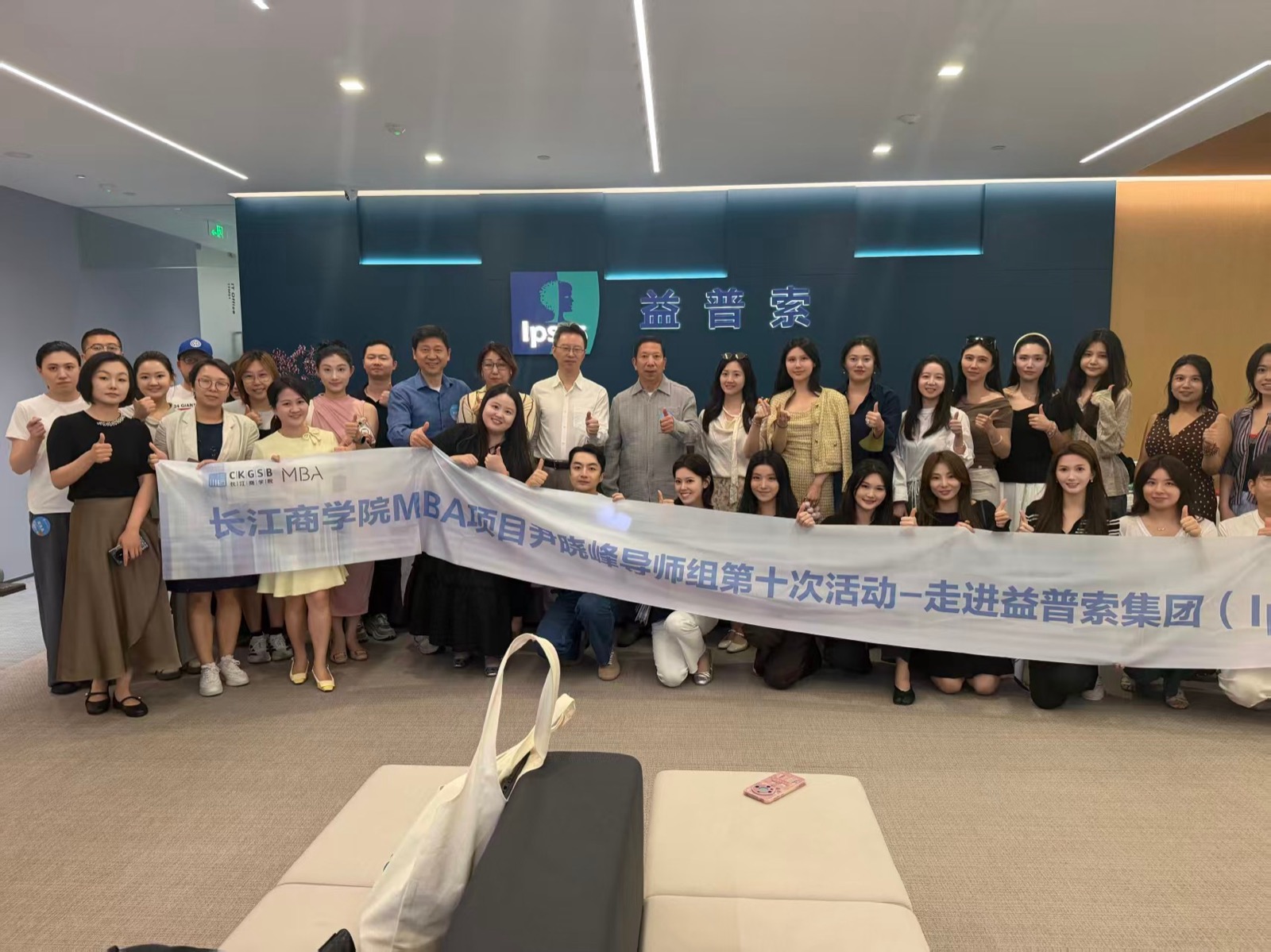
On Wednesday afternoon I was at Ipsos in Shanghai with a group from my CKGSB MBA cohort. We sat in their workshop room, the one with the one-way mirror they use for focus groups, and for nearly three hours two of their senior people told us what they are seeing as Chinese companies go abroad. It was a session for CKGSB students, not a public event. Most of the room either runs a business that has already gone overseas or is about to.
The CEO of Ipsos China opened with a story about Procter & Gamble, where he started out thirty years ago. P&G formally entered China in 1988. Its first employee in China was hired in 1986, two years earlier, and he was a market researcher. He used the old saying about going to war: before the army moves, the supplies go first. The research is the supplies.
I have been repeating that story to founders since Wednesday, in both directions.
Going out is compulsory. Making money out there is not guaranteed.
Ipsos China's managing director and head of capability building went first. She opened with one chart, and she said it is the one she always uses.
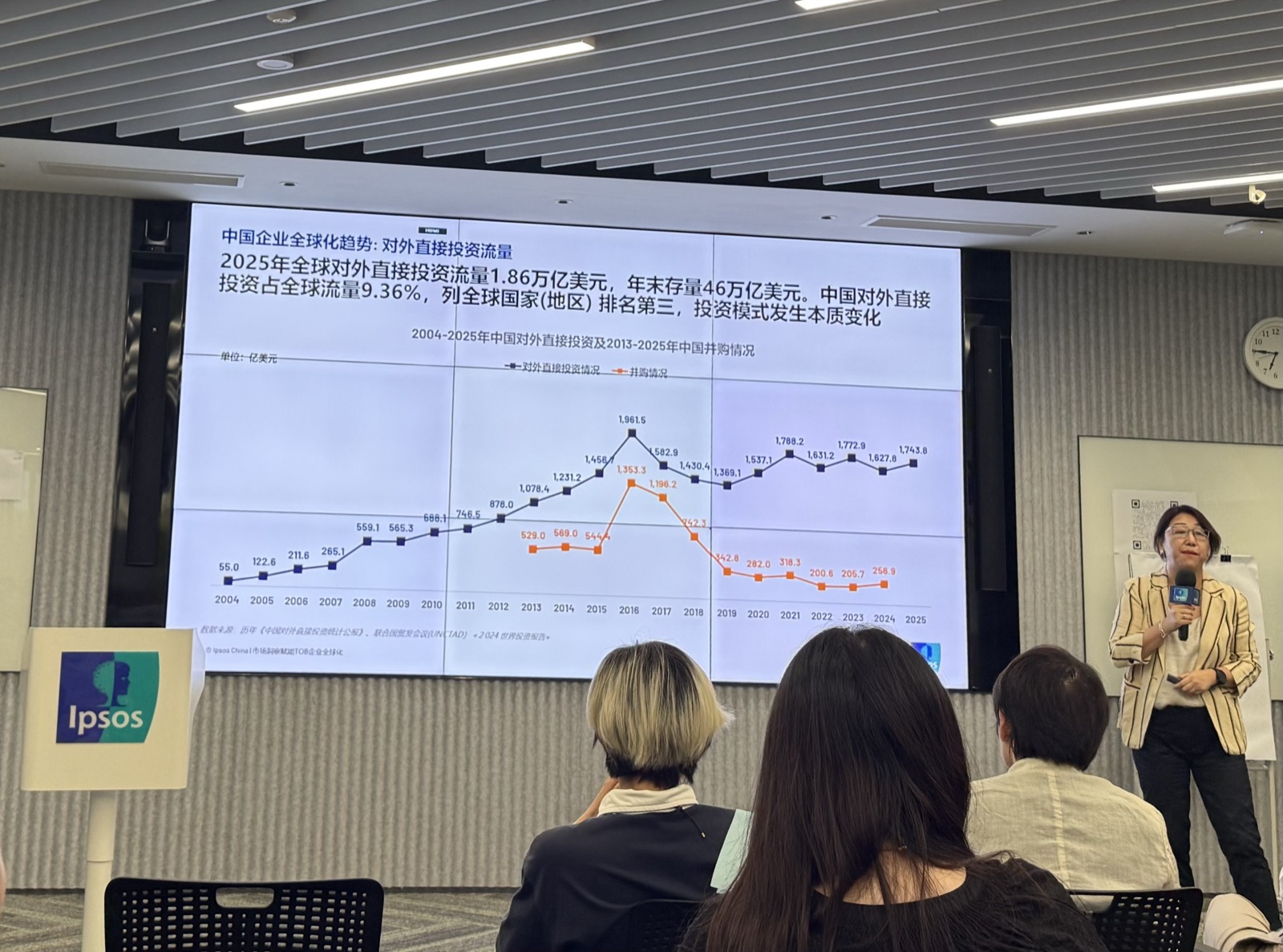
On Ipsos's figures, drawn from the Ministry of Commerce and UNCTAD, China's outbound direct investment was US$174 billion in 2025. That is still below the 2016 peak of US$196 billion. It is 9.36% of a US$1.86 trillion global flow, and it puts China third in the world, behind the United States and Japan. Her point was that the world outside is large, and that other people have been competing in it for a very long time.
Then she said the thing I wrote down in capitals. The number of Chinese companies going abroad keeps rising, but returns on that investment are falling. You can get out. Whether you make money out there is another question. Going abroad is compulsory now, she said, but it is not easy, and it has to be done carefully.
She gave seven things to get right: country, policy, demand, competitors, channel, brand and organisation. Two of her examples have stayed with me.
The first was Malaysia. On paper it welcomes refurbished medical equipment. But the detailed rules say you cannot sell a refurbished machine under its original brand. So you can bring in a refurbished Philips scanner, but you cannot call it a Philips. Without the name, you do not get into public hospitals. Private hospitals serve the top of the market and want new equipment. What remains is small imaging clinics buying low-end ultrasound. She put the market at 2.4 billion on paper, and the part you can actually reach at about a sixth of that. The headline policy says welcome. The detail says otherwise, and the detail had clearly been lobbied.
The second was a water-filter company entering Spain. The channel that mattered there was plumbers. Spain has a huge number of two- and three-person plumbing firms, and in home water filtration they are the influencers. A competitor that is not Spanish either had been working that channel for nearly twenty years.
Britain has the same kind of hidden gates. In the last note it was a bank account. For health devices it is MHRA classification. For a consumer brand it may be a buyer at a department store who has never heard of you. The headline policy is almost never where you get stuck.
Trust is rising, and it is not coming from price
Ipsos China's CEO took over with Ipsos's brand-trust tracking. The public part is already out. In Ipsos's 29-country survey in April 2025, 49% said China would have a positive influence on world affairs, against 46% for the United States. It was the first time in ten years of tracking that China came out ahead.
The part I had not seen before is internal. Ipsos tracks about a hundred Chinese brands across the main markets. He said that last year, for the first time, net trust in those brands turned positive in the major European and North American markets. Japan was the exception.
He was clear about why. The biggest driver of trust is still quality and service. Second is doing business fairly and ethically. Third is being responsible for the environment. Price was not on the list. When Chinese brands are resented abroad, he said, it is mainly because they are too cheap.
For a Chinese brand coming to Britain, that is the whole argument in three lines. The British buyer is more open to you than five years ago, but the openness depends on things price cannot buy.
The toothpaste box
A classmate who runs the China business of a century-old American running brand asked the next question. Head office wants one global image. His Chinese customers want something else. How do you break through in China without breaking the global frame?
The CEO answered with another P&G story. Crest came in a white box in the United States. In 1990s China, toothpaste was sold through small family-run shops, and a white box on those shelves was grey with dust within a week. So the China team changed the colour of the box. Packaging is one of the most protected parts of a brand, and the change went all the way up to P&G's global CEO, who approved it.
His rule was this: keep the strategy consistent, and make every piece of execution local. Most failures, he said, happen in execution, and execution only works if it is local.
My question: what about British brands?
Then I asked mine. I told him what we do at Metis, which is taking Chinese brands into Britain and British brands into China, and I described something I keep running into. A British or European brand that is established at home wants to come to China and assumes it needs no localisation. It thinks good marketing will be enough, because the brand already works in Europe. How do you convince them otherwise?
His answer was more honest than I expected. You don't have to convince them, he said. China's population is big enough that a brand can come in completely unchanged and still sell. If ten people buying it is enough for you, don't change anything.
But if what you want is ten million people, the conversation is different. First you agree with the brand owner who the target customers are. Then you find out what would actually draw them in and what problem they have. Then you change things to meet it. His example was the simplest one there is. They will say, "I can't read the English. I need a Chinese name." If you want to sell to them, he said, you change it.
I have been thinking about that answer since. It changes the question British founders ask me. They ask whether they should localise, as though it were a matter of taste or of brand integrity. The real question is which number they are aiming for. Almost every British founder I meet says they want China, and almost all of them mean something closer to ten million than ten. Then they budget, plan and brief as if ten were enough.
The timing matters. On 8 September, in his first call with Prime Minister Andy Burnham, Xi Jinping said China would further open its education, healthcare and financial sectors over the next five years. Those are exactly the British sectors we work with, and they are the ones where a Chinese customer has to trust you before paying anything. You cannot build that trust with ten customers and an English-only name.
"Too perfect"
The other thing I raised was from our own work. We use AI heavily at Metis for creative content and brand storytelling, including short videos for TikTok. The cost savings are real. But founders keep telling us the result is too perfect: the product looks too flawless, and so does the presenter. So we now add constraints to our prompts. The product cannot look this perfect. The presenter cannot look this perfect. AI has cut our production cost, but it has not cut the time we spend going back and forth with the client until they are happy.
The CEO asked me a question back. Who said it was too perfect: your team, the consumers, or the brand owner? The brand owner, I said.
Then you need to know whose opinion you are working to, he said. If consumers told you, from interviews, from data, from watching real people react, take it very seriously. If it is only the brand side, you do not yet know what is behind it. He suggested, half joking, that it might just be a founder watching AI do the work and wondering where they fit in.
He was right that I had not asked. But I think the founders are also onto something. Polish reads differently in each market. A British viewer who is scrolling reads a flawless presenter as an advert and scrolls on, and a slightly awkward one reads as a person. So "too perfect" may be the founder picking up what the customer will feel. The only way to know is to ask the customer, which was his point.
The rest of the afternoon backed this up from several directions. The CEO said the fundamentals of marketing have not changed with AI. You still bring in new customers, keep them, and get them to recommend you. If every brand uses the same tools, every brand ends up looking the same. He also said audiences are already tired of feeds where the script, the presenter and the targeting are all AI. He told us about a children's toothbrushing campaign where the best idea came from people. A team had put the brief to several AI tools, Doubao among them, and none of them came up with it. Ipsos's own position is "AI-augmented, human-led". Another classmate had licensed the faces, voices and knowledge of well-known Chinese medicine doctors for digital avatars. However well the AI copied them, she said, viewers still felt no warmth.
The managing director covered GEO, which means getting your brand into the answers AI search tools give. She said the market was chaotic six months ago and is only now settling down. Her advice on choosing an agency was to ask how they work out what customers are actually asking the models, how solid their data is, and whether their targets are realistic. Anyone who promises you first place in three months is not being rational, she said.
The same answer, in both directions
A Chinese brand coming to Britain and a British brand going to China are making the same decision, and most of them make it without noticing. Decide how many people you want to reach, then find out what those people need, from the people themselves and not from your own team.
If ten is enough, arrive as you are. Plenty of brands do. If you want ten million, the strategy stays the same and everything else gets translated, down to the name and the colour of the box.
What I took home from the CEO was simple. AI has changed how fast we make things. It has not changed what marketing is for.
Sources: Session for CKGSB MBA students, "Corporate globalisation strategy and AI marketing", Ipsos China, Shanghai, 23 September 2026, with the CEO of Ipsos China and Ipsos China's Managing Director and Head of Capability Building, from my own notes and recording; Ipsos, "America's reputation drops across the world", 29-country survey, 17 April 2025; Ministry of Commerce of China and UNCTAD outbound investment figures as presented by Ipsos; Ministry of Foreign Affairs of China, President Xi Jinping speaks with UK Prime Minister Andy Burnham, 8 September 2026; DBT China trade and investment factsheet, 24 September 2026
One email a month. What moved, and what it means.
Trade, policy, platform and regulatory changes that affect a brand crossing between Britain and China, in both directions. No pitch, unsubscribe any time.
This note is discussed on LinkedIn, where we reply to every comment. You can also write to us directly.
Reply by email